
What If Nobody Answers? (The Fear Behind the Fear)


Silence after a question doesn’t necessarily mean the question failed. Sometimes it means people are thinking.
You’ve decided to try it.
Instead of explaining the next point in your lesson, you ask the class a question.
It’s a good question, too. You thought about it while you were preparing. It doesn’t have an obvious yes-or-no answer. It gives people an opportunity to think about the passage and say what they see.
So you ask it.
And nobody says anything.
Three seconds pass.
Then five.
Someone looks down at his Bible.
Someone else suddenly seems very interested in her coffee.
By about seven seconds, you’re beginning to wonder whether the question even made sense.
So you do what almost every teacher has done at one time or another. You answer it yourself . . . and somewhere in the back of your mind, you think, “Well, so much for discussion.”
But what if the silence didn’t mean your question failed?
What if they were just thinking?
Silence Feels Longer When You’re the Teacher
When you’re standing in front of a class waiting for someone to answer, five seconds can feel like five minutes. We’re accustomed to filling silence. Teachers may be especially uncomfortable with it because we feel responsible for keeping the lesson moving. If nobody responds quickly, our instinct is to rescue the moment.
We rephrase the question.
Then we rephrase it again.
Sometimes we turn it into an easier question.
And if none of that works, we answer it ourselves and move on.
The problem is that we may be training our class not to answer.
Think about what happens from their perspective: If experience has taught them that the teacher will answer his own question after four or five seconds, why do the work of formulating an answer? They know that if they wait just a little longer, the teacher will take care of it. And a class that has spent years primarily listening may need even more time.
They may be wondering:
Does he really want us to answer?
Is there a particular answer he’s looking for?
What if I say something wrong?
Or perhaps they’re simply doing exactly what you asked them to do… They’re thinking.
Jesus Sometimes Let a Question Do Its Work
Jesus frequently used questions in His teaching, and I bet He didn’t always rush to give the answer. Consider this famous passage:
“Who do people say that the Son of Man is?” He asked His disciples in Matthew 16:13.
They answered.
Then Jesus made the question personal:… “But who do you say that I am?” (Matthew 16:15)
That question required something from them. They couldn’t simply listen to Jesus explain who He was. They had to consider what they believed and put it into words.
Peter eventually answered, “You are the Messiah, the Son of the living God.” The question helped bring something to the surface that a lecture alone would not have revealed.
Of course, our questions don’t carry the authority of Jesus’ questions. But His example reminds us that sometimes a question needs room to do its work.
Give Them Permission to Think
Sometimes I’ll even give the class advance warning: “I’m going to ask you a question, and I’m going to give you a few seconds to think before anybody answers.”
That takes some of the awkwardness out of the silence. Nobody has to rush to fill it. You’ve already told them that thinking time is part of the plan. Then actually give them those few seconds.
Don’t apologize for the silence.
Don’t immediately rephrase the question.
Don’t start dropping hints.
And don’t answer it yourself.
Look comfortable, even if you aren’t.
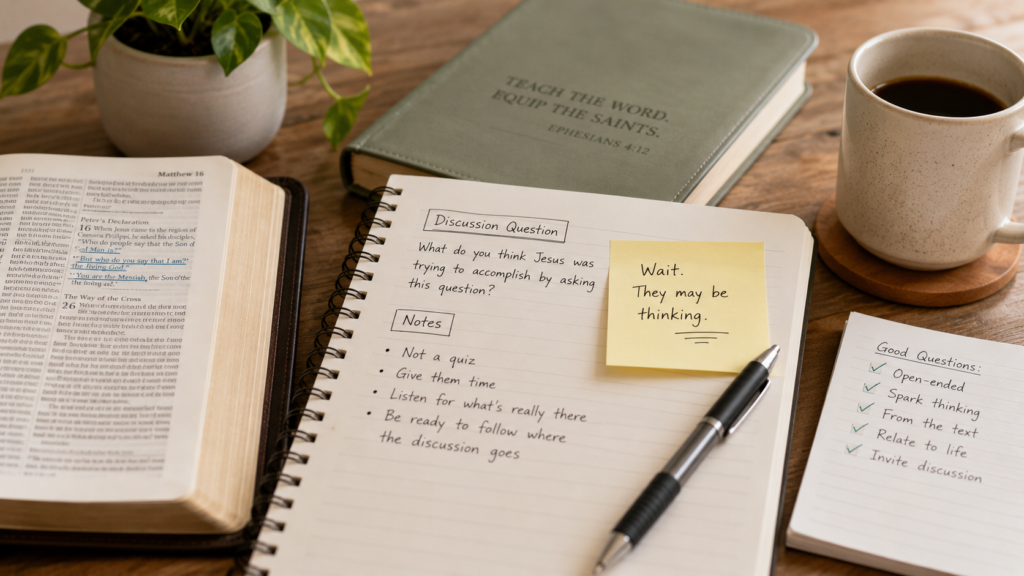
You may be surprised what happens when people realize you genuinely intend to wait for them. Someone who rarely speaks may look up and offer a tentative thought. Another person may build on it. Someone else may see something in the passage you hadn’t considered. And now you’re no longer trying to manufacture a discussion.
You’re actually having one!
Not Every Silence Is Productive
Of course, sometimes nobody answers because the question really wasn’t very good. (It happens to the best of us!)
Maybe it was confusing.
Maybe it required information the class didn’t have.
Maybe it was so broad that nobody knew where to begin.
Learning to recognize and write good discussion questions is an important skill, and we’ll talk more about that later. But don’t diagnose the question too quickly. A few seconds of silence isn’t enough evidence. Especially when you’re introducing discussion to a class accustomed to lecture, silence may simply be part of the transition. You’re asking people to participate in a different way, and they need time to learn that when you ask a question, you actually want to hear what they think. So the next time you ask a question and nobody answers immediately, resist the urge to rescue the room.
Wait.
Let them look at the passage.
Let them think.
Let the silence feel a little uncomfortable.
Because if you ask people to think, you have to give them time to think.
Steve Guidry writes regularly about teaching with questions. You can read more of his articles at StevesBibleQuestions.com. Or contact him directly at [email protected]. He reads and responds to every note.
Responses